
The page you were trying to view is not available for your role.
In order to aid your understanding, the underlined terms are hyperlinked to definitions in our online investment glossary.
Our market summary
The third quarter of 2026 was shaped by a mix of challenges and resilience. Geopolitical tensions in the Middle East pushed oil and gas prices higher, adding to inflation pressures and prompting many central banks to raise interest rates. Despite this backdrop, economic growth remained stronger than expected, particularly in the US, while company earnings generally continued to improve. Investors remained enthusiastic about artificial intelligence (AI) and related technologies, helping global equities end the quarter up by 1.6%. Commodities performed strongly, while bond markets struggled as rising inflation expectations and higher interest rates pushed yields upwards.
US
US
US equities delivered a return of 2.2% during the quarter, supported by resilient economic growth, healthy company earnings, and continued investment linked to AI. The US remained the main engine of developed market growth, with strong business investment and a firm labour market helping to support confidence. Energy stocks performed particularly well as oil prices rose, while software and technology also benefited from investor enthusiasm for AI. Investors largely looked through concerns around inflation and higher bond yields leading to record market highs.
The performance figures shown refer to past performance. Past performance is not a reliable indicator of future performance.
Europe
Europe
European equities saw losses of 2.7% over the quarter and lagged many global peers. Investors questioned whether companies in the region could match the earnings growth seen elsewhere, particularly in the US. Concerns over rising interest rates and the impact of higher bond yields on economic growth also weighed on sentiment. While improving economic activity and increased fiscal spending plans provided some support, particularly for defence and infrastructure-related businesses, Europe’s lower exposure to AI-driven growth themes limited investor enthusiasm.
The performance figures shown refer to past performance. Past performance is not a reliable indicator of future performance.
UK
UK
UK equities delivered a return of 2.4% and held up better than many European markets. The UK benefited from its greater exposure to energy, commodities, and financial companies, sectors that were supported by higher energy prices and rising interest rates. Attractive valuations and comparatively strong dividend yields also helped maintain investor interest. While UK shares did not enjoy the same level of AI-related excitement seen in the US, their sector composition proved beneficial in an environment where inflation concerns, and higher bond yields, remained key.
The performance figures shown refer to past performance. Past performance is not a reliable indicator of future performance.
Japan
Japan
Japanese equities was the strongest-performing developed market during the quarter, up by 6.0%. Strong earnings growth, accelerating share buyback activity, and ongoing corporate governance reforms continued to support investor confidence. Although rising interest rates and higher bond yields created volatility across global markets, Japanese companies generally demonstrated strong profitability and shareholder-friendly behaviour. These factors helped overcome broader economic concerns and reinforced Japan’s position as one of the standout equity markets during the period.
The performance figures shown refer to past performance. Past performance is not a reliable indicator of future performance.
Emerging markets
Emerging markets
Emerging market equities were weaker than developed markets and declined by 0.3% during the quarter. Performance was affected by a global sell-off in semiconductor stocks during July, which weighed on several key emerging market markets and companies. However, earnings expectations across emerging markets continued to improve, particularly for businesses linked to technology and semiconductor production. While short-term market performance was disappointing, investors remained optimistic about future profit growth.
The performance figures shown refer to past performance. Past performance is not a reliable indicator of future performance.
Fixed income
Fixed income
Fixed income markets faced a difficult quarter as persistent inflation, higher energy prices, and further interest rate increases pushed bond yields higher. Investors reassessed expectations for future monetary policy, while increased government borrowing and significant corporate debt issuance created additional pressure. Longer-dated government bonds were particularly weak, as yields rose sharply. Investment grade corporate bonds also saw negative returns, while high yield bonds proved more resilient thanks to their higher starting yields and shorter duration.
The performance figures shown refer to past performance. Past performance is not a reliable indicator of future performance.
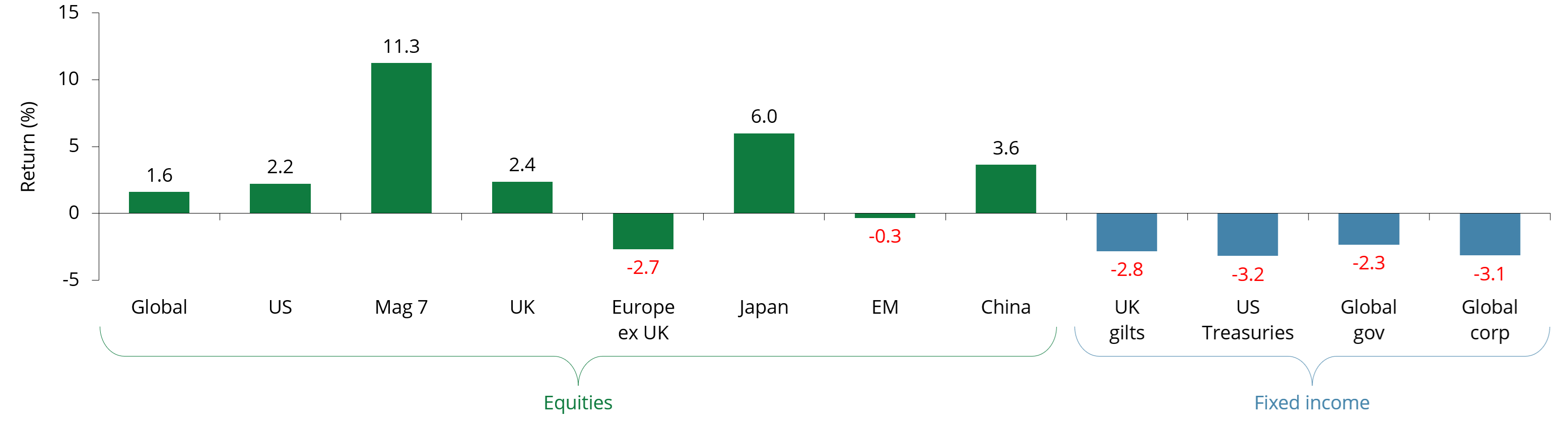
Source: Quilter as at 30 September 2026. Total return, percentage growth over period 30 June 2026 to 30 September 2026. Equities are represented by the appropriate MSCI index, the Magnificent Seven is represented by the Roundhill Magnificent Seven ETF, UK gilts is represented by the ICE BofA UK Gilt Index, US Treasuries is represented by the ICE BofA US Treasury (GBP Hedged) Index, global government bonds is represented by the Bloomberg Global Aggregate Government - Treasuries (GBP Hedged) Index, and global corporate bonds is represented by the Bloomberg Global Aggregate - Corporate (GBP Hedged) Index.
The performance figures shown refer to past performance. Past performance is not a reliable indicator of future performance.

Marcus Brookes
Chief Executive Officer and Chief Investment OfficerMarcus is both the Chief Executive Officer and Chief Investment Officer of Quilter Investors. Marcus joined Quilter Investors in December 2021 from Schroders Personal Wealth, where he also held the role of Chief Investment Officer. Marcus has considerable investment management experience with a deep understanding of the multi-asset sector, having managed multi-manager fund ranges for more than 25 years at Schroders, Cazenove Capital, Gartmore, and Insight Investments.
Approver: Quilter October 2026
QIP 24035/25/19225