The page you were trying to view is not available for your role.
In order to aid your understanding, the underlined terms are hyperlinked to definitions in our online investment glossary.
Our market summary
Global stock markets lost ground in October, ending the month down 2.4%, as enthusiasm for artificial intelligence (AI) came under renewed scrutiny. Investors questioned whether the vast sums being spent on AI infrastructure would generate sufficient returns, putting technology companies under pressure and prompting a move towards more defensive areas. Emerging markets were particularly weak, while UK equities proved more resilient. Energy, healthcare, and consumer staples were among the stronger sectors as investors favoured established businesses with more predictable earnings. Government bonds also generally performed well, providing some protection as investors became more cautious. Meanwhile, escalating tensions in the Middle East pushed oil prices higher.
US
US
US equities saw a loss of 1.8% in October. However, this masked significant differences beneath the surface. Concerns about the cost and financing of AI investment weighed heavily on technology-related stocks, particularly semiconductor companies and some of the market’s largest names. In contrast, small- and mid-cap stocks were up by 1.3% and 2.0%, respectively, highlighting broader resilience. Energy, consumer staples, and healthcare also performed well as investors moved towards more defensive companies.
Europe
Europe
European equities were mixed, down by 1.0% overall, with defensive sectors providing support while political and fiscal uncertainty in France weighed on sentiment. Concerns over French government borrowing costs put pressure on financial companies, particularly banks, while worries about AI investment affected technology stocks. Energy and consumer-focused sectors were more resilient. Eurozone economic growth slowed to 0.4% in the third quarter, while the European Central Bank kept interest rates unchanged at 2.5%.
UK
UK
The UK was the strongest-performing major equity market in October, ending the month up 1.3%. The market benefited from its relatively high exposure to energy and defensive sectors such as healthcare, consumer staples, and utilities, which proved attractive as investors became more cautious. UK inflation rose to 3.5%, while the Autumn Budget prompted a relatively muted market reaction.
Japan
Japan
Japanese equities had a difficult month in October seeing a loss of 5.0%. Growing concerns about how investment in AI infrastructure would be funded and whether it could be maintained put pressure on technology-related businesses. Meanwhile, cybersecurity concerns added to market uncertainty. Financial companies also struggled as long-term bond yields declined. Higher oil prices and wider geopolitical uncertainty added to negative sentiment. However, defensive areas, including pharmaceuticals and energy-related stocks, held up better than the wider market.
Emerging markets
Emerging markets
Emerging market equities were among October’s weakest performers, falling by 8.8%. Technology-heavy Asian markets were hit particularly hard as investors reassessed the outlook for AI spending. Korea and Taiwan suffered sizeable declines, while Indonesia also fell sharply. Meanwhile, political developments hurt Brazilian equities following President Lula’s unexpected election victory. India proved more resilient, while Mexico was the strongest emerging market, supported by improving economic activity and more encouraging inflation data.
Fixed income
Fixed income
Government bonds generally performed well as investors sought higher-quality assets amid falling equity markets. US Treasuries gained 2.4%, while UK gilts were also up by 1.6%. Investment-grade corporate bonds also benefited from falling government bond yields, although high-yield bonds were less resilient. European high yield was particularly weak amid concerns about France and AI-related financing.
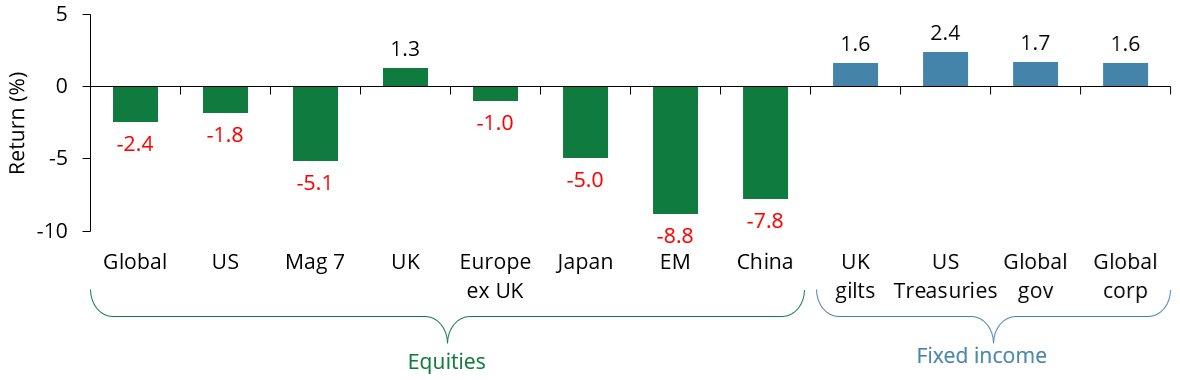
Source: Quilter. Total return, percentage growth over period 30 September 2026 to 31 October 2026. Equities are represented by an appropriate MSCI index, the Magnificent Seven by the Roundhill Magnificent Seven ETF, UK gilts by the ICE BofA UK Gilt Index, US Treasuries by the ICE BofA US Treasury (GBP Hedged) Index, global government bonds by the Bloomberg Global Aggregate Government - Treasuries (GBP Hedged) Index, and global corporate bonds by the Bloomberg Global Aggregate - Corporate (GBP Hedged) Index.
The performance figures shown refer to past performance. Past performance is not a reliable indicator of future performance.

Marcus Brookes
Chief Executive Officer and Chief Investment OfficerMarcus is the Chief Investment Officer at Quilter and a portfolio manager of the Cirilium Portfolios, Creation Portfolios, and Smoothed Funds. He joined Quilter in December 2021 from Schroders Personal Wealth.
Marcus has considerable investment management experience with a deep understanding of the multi-asset sector. He has managed multi-manager fund ranges for more than 25 years at Schroders, Cazenove Capital, Gartmore, and Insight Investments.
Approver: Quilter November 2026
QIP 24369/29/19657