
The page you were trying to view is not available for your role.
The market volatility of the last few weeks can make it hard to see the bigger picture. Falling share prices, quick recoveries, and fast-moving headlines attract attention and can be unsettling for investors.
The recent market falls and subsequent rebounds are a reminder that markets can move quickly in both directions.
When markets move quickly, whether up or down, it can also be easy to feel that something fundamental has shifted. Yet periods of volatility are a normal part of investing and, so far, there is little to suggest that the longer-term picture has materially changed.
Global equities remain ahead of where they started the year, and in that wider context, the recent turbulence looks more like a bump in the road than a change in the longer-term story.
Understanding what has been driving the recent uncertainty can help put those movements into perspective.
Technology driving market uncertainty
Much of the recent volatility has centred on the US technology sector.
Technology companies have grown to represent a significant part of major global stock markets. This means movements in a small number of very large companies can have an outsized influence on wider markets.
There has also been a lot for investors to digest in a short space of time.
Recent political developments in the US have coincided with renewed questions about the amount companies are spending on artificial intelligence infrastructure.
These developments have come after a period of significant market gains. Share prices in some areas had reached record levels and expectations for technology companies were particularly high.
When expectations are elevated, investors can become more sensitive to news that challenges them. Even relatively small changes to the outlook can therefore result in larger movements in share prices.
That doesn't necessarily mean investors have suddenly become pessimistic about technology or artificial intelligence. Instead, markets are reassessing what they are prepared to pay today for the growth they expect these businesses to deliver in the future.
The long-term technology story remains
It is also important to separate short-term movements in share prices from the longer-term outlook for technology.
Artificial intelligence isn't going to disappear because technology shares have experienced a few volatile weeks. AI and the infrastructure needed to support it are becoming increasingly important to businesses and the wider global economy.
However, even businesses with attractive long-term prospects can experience periods when their share prices fall. A good company and a good investment are not always the same thing at every price.
Recent developments are therefore a useful reminder that expectations matter, particularly when valuations are already high. They don't necessarily undermine the longer-term case for technology, but they do show why investors need to consider the price they are paying for future growth.

Looking beyond technology
While technology shares have attracted much of the attention, the wider picture remains supportive.
Company earnings have remained robust, while energy prices have fallen from recent highs. If lower energy prices continue, they could help to ease some inflationary pressure on households and businesses and reduce the pressure on central banks to keep interest rates higher for longer.
Importantly, much of the recent weakness has been concentrated in technology rather than reflecting deterioration across every part of the market.
That distinction matters for diversified investors.
Different markets, sectors, and asset classes will rarely perform in the same way at the same time. Holding a broad spread of investments can help reduce the effect that difficulties in one area have on an overall portfolio.
It is one of the reasons diversification becomes particularly important during periods of market uncertainty.
A blip in what has been a strong year
Looking at performance over a longer period can help to maintain perspective when markets are moving quickly.
The chart below shows the performance of global equity markets so far this year. The recent volatility towards the right-hand side of the chart is noticeable, but it comes after a period in which markets have made significant gains.
Returns of global equity markets in 2026
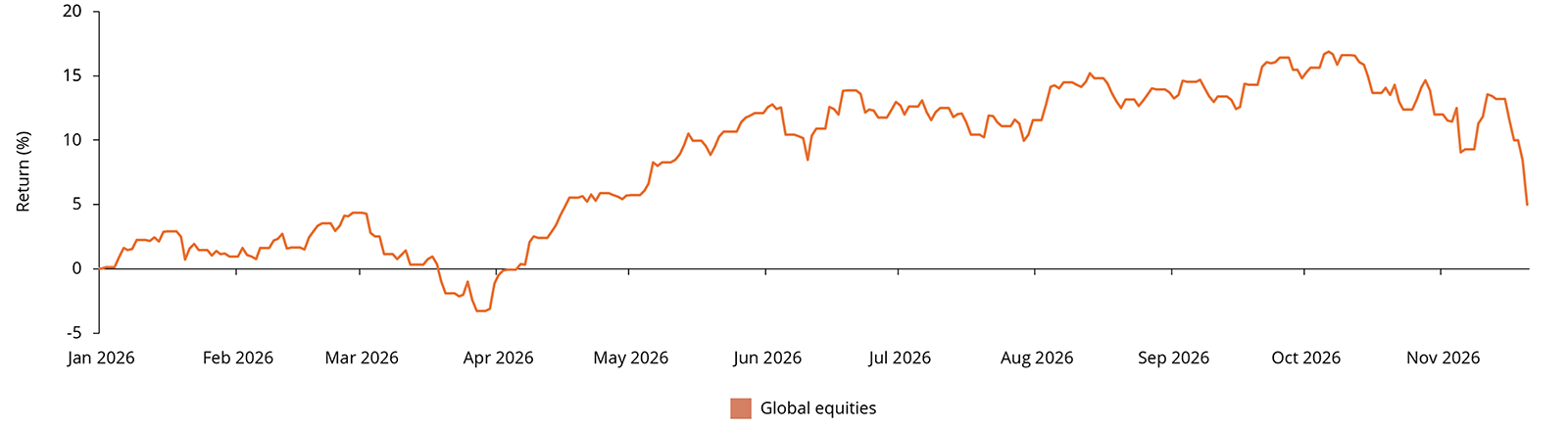
Source: Quilter, Morningstar. Total return, percentage growth over period 1 January 2026 to 23 November 2026. Global equities are represented by the MSCI All Country World Index.
Even after giving back some of the gains from earlier in the year, global equities remain above where they started 2026.
Seen in that context, the recent volatility underlines why a few trading days should not be taken as a guide to the longer-term direction of markets.
Strong years can still contain difficult weeks. Markets rarely move upwards in a straight line and periods of decline can be followed by recoveries, although the timing and extent of those recoveries cannot be predicted.
For investors, looking at the whole journey rather than focusing on a handful of trading days can provide a much more useful perspective.
Some uncertainty may remain
Putting recent volatility into perspective doesn't mean markets will immediately settle down.
There is plenty for investors to consider, particularly around technology, artificial intelligence, and the political environment in the US.
Trading conditions could also be a little less predictable around the Thanksgiving holiday in the US. When fewer investors are trading, markets can sometimes experience larger short-term movements than the news might otherwise suggest.
This could mean further ups and downs in the days ahead.
Trying to predict exactly what happens next is extremely difficult. For long-term investors, it is more useful to concentrate on the things they can control.
Staying focused on what matters
Periods of market volatility can be uncomfortable, but they are not unusual.
Investors have experienced many periods of uncertainty over the years, driven by elections, economic slowdowns, changing interest rates, geopolitical events, and developments that markets simply hadn't anticipated.
Trying to react to every headline or market movement can mean losing sight of why you invested in the first place.
Most importantly, investment decisions should continue to be guided by long-term objectives and individual circumstances rather than a few days or weeks of market activity.
Stuart Clark, WealthSelect portfolio manager, comments:
‘It was a volatile week for markets, driven by several interconnected issues. These included the market absorbing the IPO of Anthropic, which undoubtedly led to some investors reducing positions elsewhere rather than investing fresh capital; the subsequent volatility in Anthropic’s share price; the announcement of an SEC investigation into Nvidia’s accounting practices; and a US Federal Reserve Governor, Christopher Waller, discussing the potential need for a 0.5% interest rate rise in December, with the possibility of further rises to follow.
The impact was felt most acutely in the semiconductor sector, but volatility also spread into other parts of the market. We believe this has been driven primarily by investors reducing risk and borrowing in portfolios, rather than reflecting a sudden change in expectations across the market.
With the WealthSelect portfolios well positioned for a technology-led pullback, we do not see the recent volatility as changing our base case for 2027 of slower, but stable, economic growth alongside a broadening out of earnings growth.
Before the volatility of recent weeks, we already had concerns around technology centred on the high rates of growth that were still being priced into companies’ valuations, even as those valuations had become cheaper. It now feels as though there is a broader acknowledgement of that risk being reflected in share prices.
In periods like this, good investments can sometimes be caught up in the wider sell-off. That can create opportunities for active managers to selectively increase allocations to companies they believe have become oversold. We will be considering these opportunities through our ongoing discussions ahead of the next scheduled portfolio rebalance at the beginning of December.’