The page you were trying to view is not available for your role.
After a period of exceptionally strong returns from some of the world’s largest technology companies, investors have been given a reminder that markets do not move in a straight line.
The blue wave at the ballot box has quickly been replaced by a sea of red on investors’ screens, as technology stocks have sold off sharply. The immediate catalyst appears to be renewed concerns around the prospect of tougher artificial intelligence (AI) regulation, covering both AI models themselves and the vast data centre infrastructure needed to support their growth.
While the speed of the market reaction may feel uncomfortable, periods of volatility are a normal part of investing. More importantly, recent moves highlight why maintaining a well-diversified portfolio can matter when leadership within markets begins to change.
Returns of MSCI USA Index
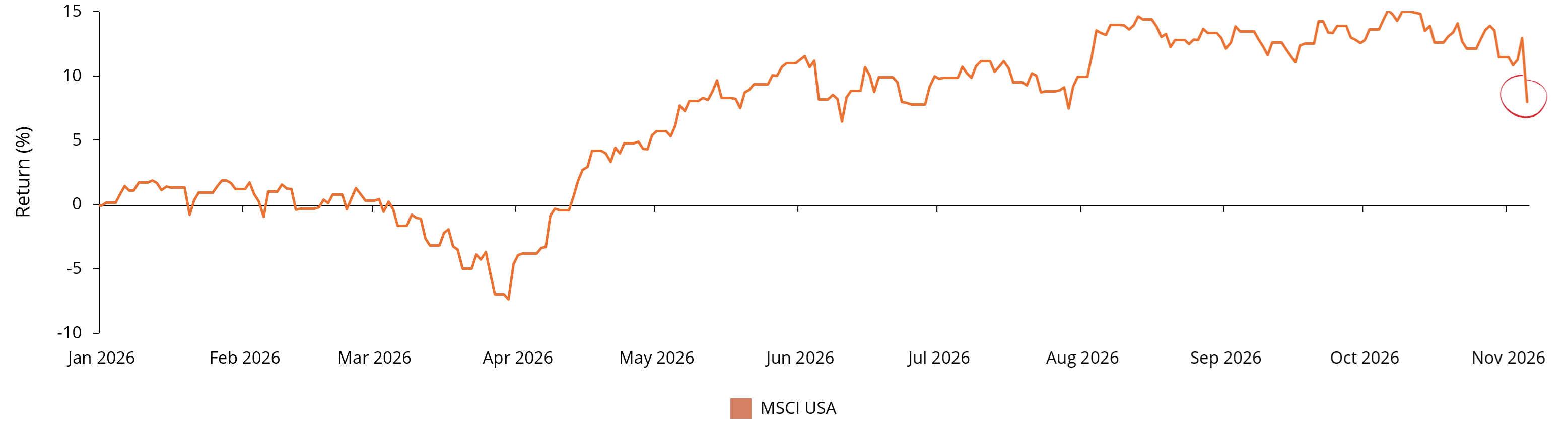
Source: Quilter, Morningstar. Total, returns, percentage growth over period 1 January 2026 to 5 November 2026.
When market concentration matters
The scale of the falls among some of the market’s biggest companies has been striking. However, investors should also consider those movements in the context of what has happened over recent years.
A relatively small group of large technology and semiconductor companies has grown to represent a significant proportion of the US equity market. Strong performance from these businesses has helped propel markets higher, but increasing concentration can work both ways.
When the largest companies prosper, their size can provide a considerable tailwind for an index. When they fall together, the same concentration can amplify weakness.
That does not necessarily mean the long-term prospects for AI or the companies developing the technology have deteriorated. Instead, the recent sell-off is a useful reminder that even companies with compelling long-term growth prospects can experience periods of significant volatility, particularly when valuations already reflect high expectations.
Not everything is moving in the same direction
Importantly, the recent weakness has not been indiscriminate. Healthcare and consumer staples have performed strongly over the past month and have proved more resilient during the latest bout of volatility, despite registering some losses.
For you and your clients, this provides a useful illustration of diversification in practice. After an extended period in which the largest US technology companies dominated both headlines and returns, it could easily have appeared that investors needed little else in their portfolios. Recent events demonstrate why that can be a risky assumption.
Holding different companies, sectors, regions, and asset classes means portfolios do not depend on one narrow area of the market continuing to outperform indefinitely. Diversification cannot prevent losses, but it can help reduce the impact when market leadership changes.
A global story, but with different impacts
Weakness in large technology businesses has inevitably travelled beyond the US.
Technology-heavy Asian equity markets have been particularly exposed. The UK market, by comparison, has a much smaller technology weighting and should therefore be relatively insulated from this particular source of volatility.
Energy markets have also been responding to a different set of pressures. Following a sharp fall at the start of the week, energy prices have edged higher as investors continue to assess uncertainty surrounding Iran and what may come next.
Taken together, geopolitical uncertainty, questions around future AI regulation and highly concentrated equity markets leave investors with plenty to digest. However, following such a strong run for technology shares, some volatility should perhaps come as little surprise. Rather than trying to predict every change in market sentiment, maintaining a diversified approach can help investors navigate periods when markets become less certain.
WealthSelect: less reliant on the US technology giants
This is also reflected in the positioning of the WealthSelect portfolios.
The chart below shows the current underweight to US equities and ‘Magnificent Seven’ technology-related companies of the WealthSelect Managed Active 5 Portfolio compared to the MSCI USA Index.
WealthSelect underweight to US equities and the Magnificent Seven
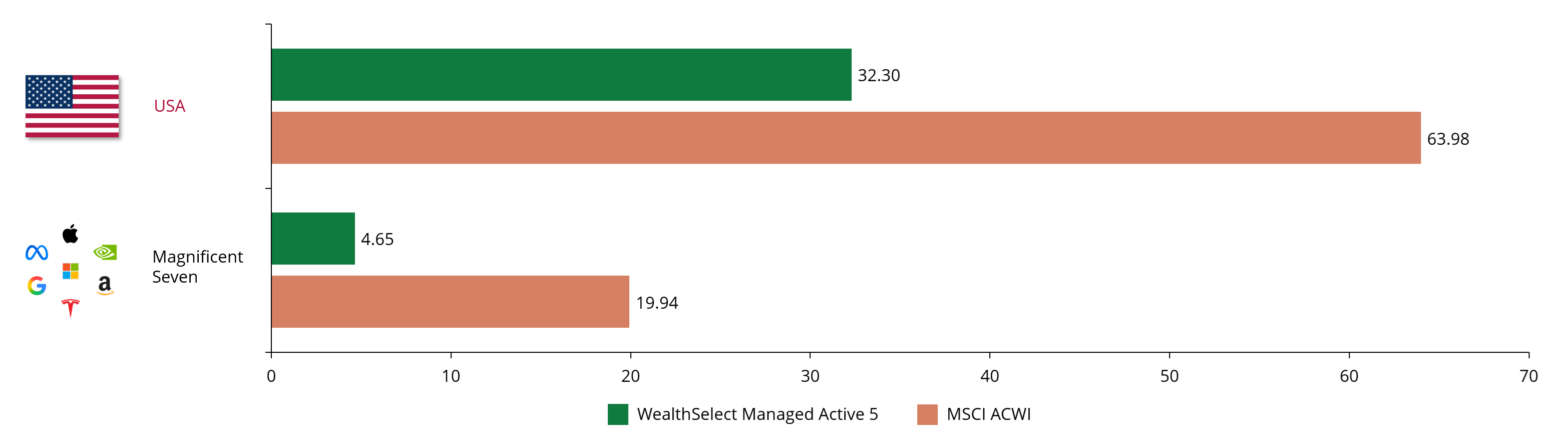
Source: Quilter, Factset as at 31 October 2026. The portfolio figures have been scaled based on the equity allocation of the portfolio.
This positioning means the portfolio is considerably less reliant on the fortunes of a small number of US mega-cap companies than the global equity index.
This does not mean avoiding US technology altogether. These remain important businesses with potentially significant long-term opportunities. Instead, the positioning reflects a broader investment approach where returns are sought from a wider range of markets, asset classes, and investment opportunities. Recent volatility provides a practical example of why that distinction can matter.
Interest rates remain part of the picture
Central banks provide another important backdrop. The Bank of England's latest rate increase itself did not surprise markets, although the unanimous nature of the decision was considered more hawkish than some had expected.
In the US, the picture is somewhat different. Falling equity markets have effectively tightened financial conditions, contributing to lower market expectations for future interest rate increases. A December rate rise is still expected and remains supported by strong economic data. However, beyond that, additional increases are likely to face greater scrutiny. Any meaningful deterioration in economic activity is likely to be reflected quickly in expectations for the future path of US interest rates.
For markets, that creates a balancing act. Strong economic data can provide reassurance over the health of the economy, but it can also give central banks greater scope to keep monetary policy tighter for longer.
Keeping short-term volatility in perspective
Periods such as this inevitably create eye-catching headlines. For your clients who have watched the same handful of US technology companies deliver exceptional returns, sharp falls can be unsettling. However, they also provide an opportunity for you to bring the conversation back to the principles underpinning a long-term investment plan.
Market leadership changes. Different regions and sectors perform well at different times. And even exceptionally successful businesses can experience significant falls along the way.
The recent sell-off therefore does not necessarily call for a change of course. Instead, it reinforces the case for avoiding excessive reliance on one company, sector, or market and maintaining a portfolio designed to participate in a broader range of opportunities.
For advisers helping clients look beyond the latest sea of red, that may be the most reassuring message of all.

Stuart Clark
Portfolio ManagerStuart is a portfolio manager of the WealthSelect Managed Portfolio Service. He joined Quilter in 2013 from Julius Baer. Stuart has more than 20 years of experience in fund research and portfolio management at organisations including BDO, UBS Wealth Management, and Julius Baer.
Stuart is a CFA charterholder and has a degree in Accounting and Finance from the University of Kent.