
The page you were trying to view is not available for your role.
Follow these 5 steps to apply for a Transitional Tax-Free Amount Certificate (TTFAC).
- Your client must have a Collective Retirement Account
- Your client has had a benefit crystallisation event (BCE) since 6 April 2006 and has not received a tax-free lump sum (Relevant BCE) since 6 April 2024 and before the certificate is issued. We will place a temporary block on relevant BCE applications whilst we assess the TTFAC application.
- If the client has not taken a tax-free lump sum since 6 April 2024, a legal representative can still apply for a TTFAC until 31 October following the end of the tax year in which a relevant lump sum death benefit is paid.
- Clients who have enhanced protection with protected lump sums will not be eligible to apply for a TTFAC because it will have no effect on their maximum tax-free lump sums that they can take from 6 April 2024.
Public sector clients and McCloud remedy
We will not be able to issue a certificate if your client is in receipt of a public sector pension and impacted by the public service pension remedy (McCloud remedy) and their choice has not yet been implemented. Their choice could impact the tax free lump sums received before the 6 April 2024.
Please note the remedy for Local Government Pension Scheme (LGPS) pensioner members is not retrospective. This means that an LGPS pensioner can apply for a TTFAC even if the remedy hasn’t been implemented yet as there will be no change to the amount of LTA used up by LGPS benefits. If the remedy is made after the 5 April 2024 and results in more PCLS being paid that will be a relevant BCE and preclude a TTFAC from being obtained if it hadn’t been issued by that point.
See HMRC pension schemes newsletter 158 for more information.
Each client will need to be assessed on a case-by-case basis to determine if a TTFAC will improve their position.
For guidance on what a TTFAC is and who may potentially benefit, please refer to the following articles:
The first step will be to gather evidence of your clients lifetime allowance usage together with details of the amount of tax-free lump sums taken before 6 April 2024. See step 3 below for details of the information you will need.
Once you have this you can use our calculator to carry out a comparison to see whether a TTFAC would be better for your client.
Transitional Regime calculator
We strongly advise you to include a screen shot of our transitional regime calculator (unless the client has primary or enhanced protection) with the application. This is to evidence that you have checked the client’s situation and are aware of the outcome before an irrevocable application is made.
The short video below explains how to use our transitional regime calculator.
How do I use the transitional regime calculator?
Our short video shows you what information you need and how to complete the calculator to see which calculation, either standard or transitional, would be better for you client.
Legislation requires ‘complete evidence’ to accompany the application. In practice, HMRC confirm that this must always include the total amount of lifetime allowance used up so a scheme administrator can determine what portion of those benefits were taken tax-free. Consequently, this may be a time-consuming process and will involve the complete breakdown of how the LTA was used up.
The evidence will need to show:
- The total percentage of the lifetime allowance (LTA) which has been used up.
- Details of historic benefit crystallisation events (BCEs) that used up LTA. This must include any LTA used up by pre A-day pensions in payment. In this situation we will need confirmation of the amount of pension in payment at the time of the first crystallisation event and the date of that event.
- The amount of the BCEs paid as following tax-free lump sums:
- Pension commencement lump sums (PCLS), including those taken after age 75*
- The tax-free element of uncrystallised funds pension lump sums (UFPLS)
- Standalone lump sums
- Serious ill health lump sums (paid before the age of 75)
- If the member has died: tax-free elements of Uncrystallised fund lump sum death benefit (or defined benefit lump sum death benefit) paid prior to 6 April 2024
*Although PCLS amounts paid after age 75 are not BCEs, their value is reflected in the TTFAC so we need to know any amounts paid.
What type of evidence will be required?
- Benefit crystallisation event (BCE) statements or other letters/correspondence from the relevant scheme that confirm:
- The name of the client.
- The date any event(s) occurred.
- The LTA used and what type of tax-free lump sum was paid (if any).
- If no (BCE) statement/letter is available, we will accept a recent letter or email from the scheme in question providing the above information.
Please note: you do not need to provide evidence for events that occurred under the client’s Quilter Collective Retirement Account as we already hold this evidence.
Download our transitional tax-free amount certificate application form.
This will be a familiar process for firms using Prompt.
To submit online via Prompt, please follow these 5 easy steps:
- Click on this link to Prompt
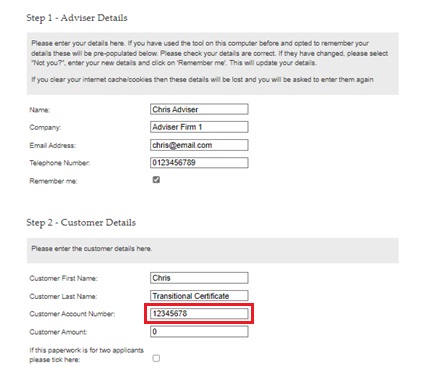
- Input your and your clients details. Please note, it is vitally important you provide the clients Account Number to allow up to process this correctly.
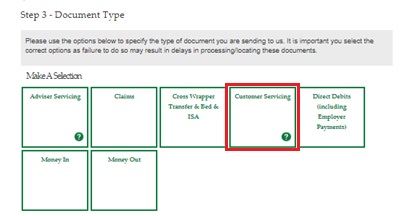
- Under document type, select ‘Customer servicing’.
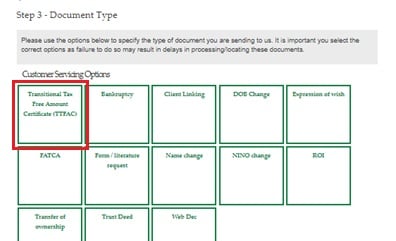
- Then select ‘Transitional Tax-Free Amount Certificate (TTFAC)’
- To allow you to email us the form and evidence, please select the relevant email preference. This is either ‘Program based’ or ‘Browser based’.
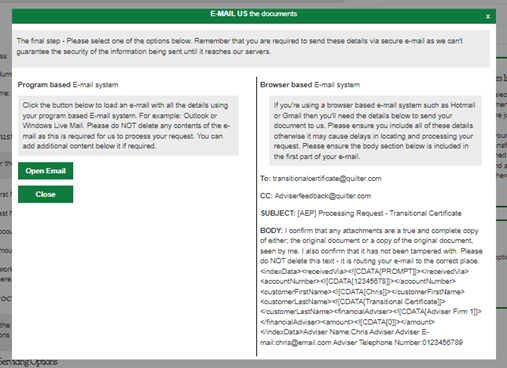
- Once the email opens, please attach the completed application form and all your evidence to the email and click send. The application will then route instantly to the Quilter work queue.
We may contact you if we have any questions that require additional information. HMRC requires pension schemes to provide a certificate within 3 months of an application. We aim to provide certificates well within this timeframe.
Useful additional support material
There is a huge amount of detail to understand. Our LTA Hub is here to help you where you’ll find a range of support articles to help you understand what it means for you and your clients.