
The page you were trying to view is not available for your role.
You have a plan for your retirement. But what happens to the pensions you leave behind?
When it comes to your pensions, you may already know the answer to some of the big questions: how much you have saved, how many pensions you have, and what kind of retirement you are on track for.
But do you know who would get that money if you died? And would every pension provider even give you the same answer?
For deaths on or after 6 April 2027, most unused pension funds and death benefits will count towards your estate for inheritance tax purposes. This means that an old beneficiary nomination form or forgotten pension pot could leave your family with an unexpected tax bill, as well as frustrating delays and uncertainty about who should receive the money.
Your adviser can help you understand who each pension could go to, how the provider makes that decision, and whether the arrangements still reflect your wishes.
The tale of three pensions
Pensions built up across different jobs and stages of life can have different rules, and your own decisions can become out of date.
Take the illustrative example of Mr Harper. He dies in May 2027, aged 78, leaving a wife, an ex-wife, and five children from his two marriages. Let’s assume his estate is already large enough that inheritance tax is payable.
He has three defined-contribution pensions (where the amount you get depends on what is paid in, investment growth and the impact of charges), each with different rules:
- Pension 1 has an up-to-date expression of wish, which outlines that he would like the money to go to his wife and their two children. The rules of this pension scheme mean that the provider makes the final decision, but his wishes and family circumstances are taken into account.
- Pension 2 still names his ex-wife and his three children from his first marriage. The rules of this pension scheme mean that this instruction is binding, so the provider must follow it despite his divorce and remarriage.
- Pension 3 has no expression of wish at all. In this case, the provider has discretion over who receives the benefits and would need to establish his family circumstances before deciding. This could add delays and uncertainty at an already difficult time.
Why the tax matters
Before the rule change in April 2027, most unused pension wealth can be passed on free from inheritance tax. This means that the decision over who receives your pension is unlikely to affect your estate’s inheritance tax position.
However, from April 2027 most unused pension wealth will be treated as inside your estate for inheritance tax purposes. This means that who gets what will suddenly impact your estate’s tax bill. Pension benefits passing to a spouse or civil partner will generally remain exempt from inheritance tax, but benefits passing to an unmarried partner, a child, or ex-spouse could be taxable.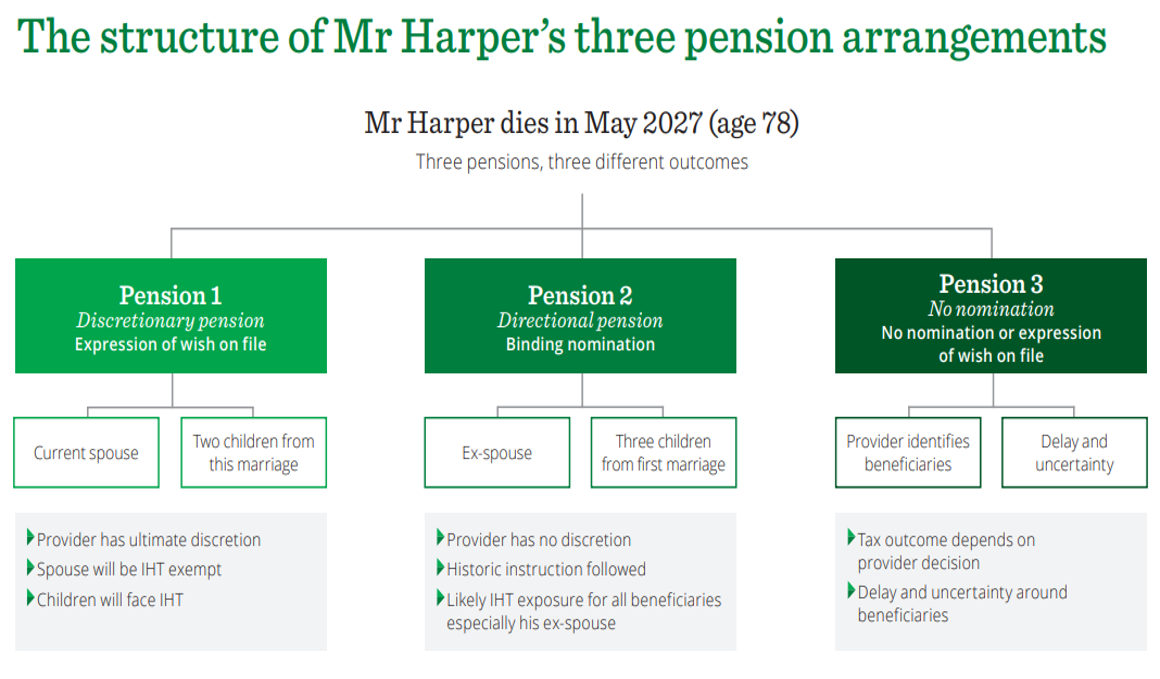
And because Mr Harper dies aged 75 or over, his beneficiaries may also pay income tax at their own marginal rate when they receive pension payments. This includes his current wife, even though benefits passing to her would generally be exempt from inheritance tax.
Having three pensions is not the issue. What matters is understanding each scheme’s rules and checking that the arrangements still reflect your wishes and family circumstances.
Three checks to make with your adviser
- Bring your pension details together. Start with the pensions you already know you have. Your adviser can help you review them. You can then work together to track down any lost pots.
- Review the people you have named. Check the expression of wish or nomination for every pension, especially those created before a big life event such as marriage, divorce, birth, or death. Your adviser can help you work out the tax implications of any decisions you need to make.
- Understand each scheme’s death benefit rules. Ask who makes the final decision, whether your nomination is binding, and what payment options your loved ones would have. Your adviser can recommend a way forward that meets your retirement needs and supports your family.
Your pensions should support your retirement first, but checking what happens to any money left behind matters too. Speak to your adviser before April 2027 to review each pension’s arrangements and understand what they could mean for the people you want to benefit.
Approver: Quilter November 2026