The page you were trying to view is not available for your role.
Whether you should save or invest depends mainly on when you will need the money and how much investment risk you are comfortable taking.
Saving is generally better for emergency funds and shorter-term goals, while investing may be more suitable for money you won’t need for several years. For most people, the answer is to do both.
What is the difference between saving and investing?
Saving means keeping money somewhere relatively secure and accessible, while investing means putting money into assets — such as shares and bonds — that may rise and fall in value in the hope of achieving greater returns over time.
Cash savings usually earn interest. This is calculated as a set percentage of the value of your savings, paid either monthly or annually. A savings account with £5,000 and paying 3% interest would earn you £150 a year.
When investing in the stock market, you typically make money when the company’s shares increase in value (or the company pays dividends to its shareholders).
|
Saving |
Investing |
|
Usually lower risk |
Value can rise and fall |
|
Usually easier to access |
Better suited to longer timeframes |
|
Useful for emergencies and short-term goals |
Potential for greater long-term growth |
|
Interest may not keep pace with inflation |
You could get back less than you invest |
Saving vs investing in numbers
3-6 months’ salary
a common rule of thumb for the amount to keep in an easy-access savings account for essential outgoings (MoneyHelper)
5 years
typically, only invest money you won’t need for at least five years (MoneyHelper)
£20,000
how much you can pay into your ISAs each tax year (GOV.UK)
When should I save my money?
Saving is generally more suitable when you might need the money within the next few years, or if you can’t afford for its value to fall.
Typically, think savings for:
- An emergency fund
- Next year’s holiday
- A car you expect to buy soon
- A house deposit you will need in the next few years
- Other planned short-term spending
There are a number of different types of savings accounts, with different rules around access.
Current accounts are your standard everyday bank accounts which you can access immediately, and some will pay interest on a certain level of savings. They sometimes have good introductory deals, but the interest rate drops to near zero after a few months.
Instant and easy-access accounts are useful for money you want instant access to, while fixed-term deposit accounts or bonds pay a guaranteed interest rate for a set period of time. The rate is typically higher, but your money is locked away.
You could also opt for Premium Bonds — which work as a monthly lottery-style draw rather than paying an interest rate — or a regular savings account, which lets you save a set monthly amount in return for a higher rate (but you might not be able to withdraw the money).
Any interest earned on cash held within a cash ISA is tax-free, and you can pay in up to £20,000 a year across your ISAs (HMRC).
Outside of an ISA, you can earn up to £1,000 a year from savings interest tax-free if you are a basic-rate taxpayer, or £500 if you are a higher-rate taxpayer. Additional-rate taxpayers get no savings tax-free allowance at all (HMRC). And the rates of tax on savings outside of an ISA are set to increase by four percentage points from 6 April 2027.
|
|
Savings allowance |
The tax rate on savings above the allowance before 6 April 2027 |
The tax rate on savings above the allowance after 6 April 2027 |
|
Basic-rate taxpayer |
£1,000 a year |
20% |
24% |
|
Higher-rate taxpayer |
£500 a year |
40% |
44% |
|
Additional-rate taxpayer |
£0 a year |
45% |
49% |
When should I consider investing?
Investing may be worth considering if you won’t need the money for at least five years and you’re comfortable with its value going down as well as up.
Stock market returns are historically better than cash returns over the long term, so it’s worth considering investing for your longer-term goals.
Data from Quilter’s Investing in Uncertain Times report, published 2026, shows that if you had invested in the global stock market 30 years ago, your money would be worth more than 13 times its original value and more than five times the value it would have grown to if it had been held in cash.
According to the research, £10,000 earning the Bank of England’s base rate each year would have grown to £23,637 between 1996 and 2026. If it had been invested in global bonds, it would be worth £40,759. The same lump sum invested in stocks and shares from around the world would be worth £132,932.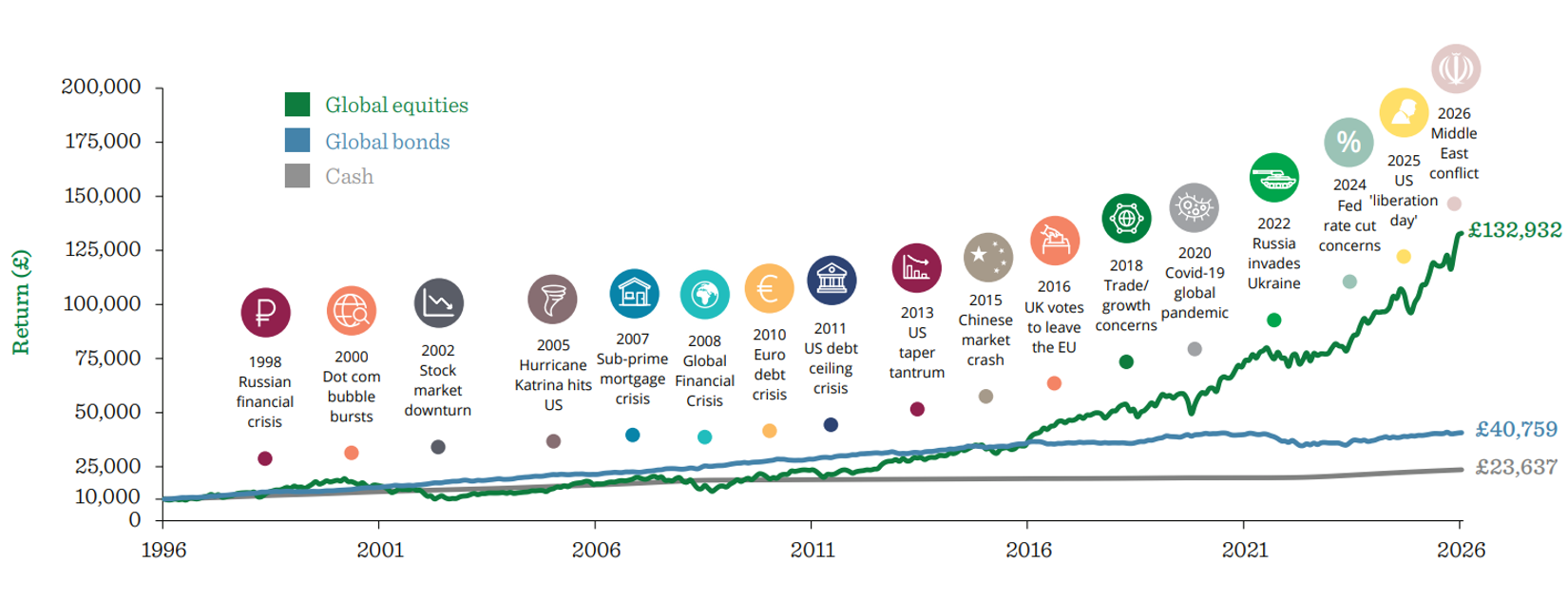
Source: Quilter and Morningstar as at 30 June 2026. Total return, percentage growth over period 1 July 1996 to 30 June 2026. Global equities: MSCI All Country World Index. Global bonds: Bloomberg Global Aggregate Index. Cash: BoE Base Rate.
And while there are times when cash might be the right fit for you, it’s not risk-free. If the returns on your cash do not match or beat inflation, your money loses value in real terms. If you put £10,000 in cash in 2026, it will be worth just £6,730 by 2046 if prices rise by 2% a year. If prices rise by 5% a year, it will be worth just £3,769, according to Quilter’s analysis. It is important to note that past performance is not a reliable indicator of future performance.
Should I save and invest at the same time?
Yes, it’s worth treating your money for tomorrow as different from money you are putting away for 10 or 20 years’ time — they have different jobs.
- Emergency fund → save
- Holiday next summer → save
- House deposit needed in two years → save
- Money for a goal 10 years away → consider investing
- Retirement decades away → investing is likely to be much more relevant
When deciding whether to save or invest, it’s worth looking at your finances as a whole. This can help you spot any gaps and decide what to prioritise, which may answer the question of ‘do I save or invest?’ for you.
Ask yourself:
- Do I have expensive debt? If the answer is yes, deal with that first.
- Do I have emergency savings? If the answer is no, build an accessible savings buffer first.
- When will I need this money? If the answer is within the next five years, saving is likely to make more sense. If the answer is five or more years away, consider investing.
- Can I afford to lose some of the value of this money? If not, investing may still not be suitable.
- What is the money actually for? Work out a goal for the money and check that investing still feels like the correct home for your cash.
Frequently asked questions
Yes, you can transfer money between ISAs. To keep it tax-free, you must transfer it (rather than withdraw the money and then put it into a different account). The move does not affect your £20,000 allowance.
Choose your new provider and open the account, fill out an ISA transfer form, and then let the providers handle the transfer. All providers must accept transfers out of an ISA, but they don’t have to accept your transfer in, so double check with your new provider before opening an account.
The Financial Services Compensation Scheme covers eligible cash savings up to £120,000 per person per firm, so you may get your cash savings back if a regulated, protected company went bust. Check that your separate bank accounts are not under the same banking group (such as HSBC and First Direct) as your total protection across those brands is still capped at £120,000.
It covers investments up to £85,000 per person per firm, but not all investments are covered and it does not cover investment losses from falling markets.
Compound growth is growth on growth — the returns on your investments can generate further returns themselves.
For example, if an investment of £100 grew by 5% in year one, it would grow by £5 to £105. If it grew by 5% again in year two, it would grow by £5.25 to £110.25. If it grew by 5% again in year three, it would grow by £5.51 to £115.76.
Approver: Quilter November 2026