The page you were trying to view is not available for your role.
How do I start investing?
The simple list is: 1) choose an investment platform, 2) choose an investment account, and 3) choose your investments.
In reality, though, there is more to think about. You need to decide what you’re investing for, make sure you do not need the money in the short term, and understand the level of risk you are comfortable taking.
Five questions to ask yourself before investing
- Do I have expensive debt?
- Do I have emergency savings?
- Will I need this money within the next few years?
- Would I cope financially if its value fell?
- What am I ultimately investing for?
Start with clearing expensive debts, as investment returns may not outweigh the interest you’re paying.
Next, check your emergency fund. A general rule of thumb is to keep three to six months of essential outgoings, such as rent, bills, and food, in an instant-access savings account (MoneyHelper). And typically, only invest money you won’t need for at least five years (MoneyHelper). This gives it more time to ride out the stock market’s ups and downs.
Being ready isn’t about a magic number in the bank, but about having secure finances and enough time to stay invested for the long term.
Key facts box
- £20,000 – how much you can pay into ISAs each tax year (HMRC)
- 100% of your earnings – how much can usually be paid into your pension each tax year while still qualifying for tax relief (capped at £60,000) (HMRC)
- 55, rising to 57 in 2028 – the ‘normal minimum pension age’, the age at which you can usually access your personal pensions (HMRC)
Investing at a glance
- ISA – Individual Savings Account, typically good for medium-term, tax-efficient investing
- Pension – typically good for long-term, tax-efficient investing, comes with specific tax and access rules
- Shares – owning a share of a company (also known as stocks)
- Bonds (or ‘fixed-interest securities’) – where you lend money to a government or company in exchange for interest
- Cash – money held in cash or cash-like assets
- Fund – a pre-made ‘basket’ of investments
- Dividends – income paid by a company to its shareholders
What is the difference between saving and investing?
Saving generally means keeping your money somewhere accessible and secure, such as a bank or building society account. Investing means putting your money into assets that can rise or fall in value in the hope of achieving a higher return over time.
Historically, the stock market has produced higher returns than cash savings, so for long-term goals it could be worth considering investing.
According to Quilter’s Investing in Uncertain Times report, published 2026, a £10,000 investment in global stocks in 1996 would be worth £132,932 after 30 years. Meanwhile, £10,000 in global bonds would be worth £40,759 and £10,000 in cash would be worth just £23,637.
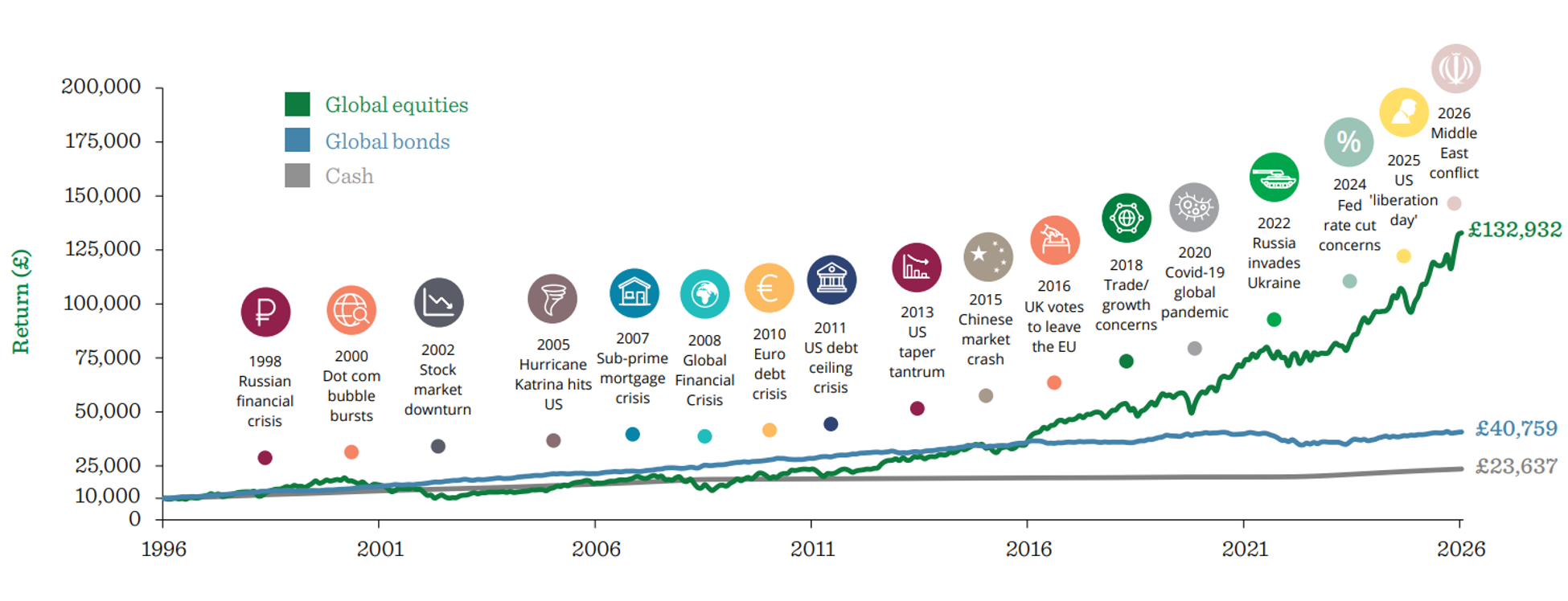
The performance figures shown refer to past performance. Past performance is not a reliable indicator of future performance.
Source: Quilter and Morningstar as at 30 June 2026. Total return, percentage growth over period 1 July 1996 to 30 June 2026. Global equities: MSCI All Country World Index. Global bonds: Bloomberg Global Aggregate Index. Cash: BoE Base Rate.
What can I actually invest in?
Common investments include shares and bonds, as well as investment funds.
When you buy a share, you are buying a small stake in a company, such as Microsoft or Lloyds Bank. If the company’s share price goes up, so does the value of your share. If you sell for more than you paid, you make a profit. If you sell for less, you make a loss.
When you buy a bond, you are essentially buying an I-owe-you from a government or a company. You lend them money, and they pay interest on the loan, known as a coupon.
Bonds vary in risk and there is a chance that the bond issuer cannot repay its debt, but at the end of the agreed term (known as maturity), you will get your money back if it can pay. Riskier bonds typically come with higher interest payments.
The value of the bond can also rise or fall, so you can make or lose money by selling the bond on the open market.
When you buy an investment fund, you are buying a pre-made basket of investments. If buying one company’s share is like buying one ingredient, buying an investment fund gives you a basket containing lots of different ingredients.
Investment funds can help with diversification, an important aspect of investing. Diversification means spreading your money across different investments, companies, asset classes, or countries so that your returns aren’t dependent on the fortunes of a single investment.
It doesn’t remove investment risk, but it reduces your reliance on one part of your portfolio and can be a good way to get started if you are unsure. Some funds are run by a fund manager who will select and manage the assets for you.
What account should I use to invest?
For many people beginning to invest, a stocks and shares ISA is one of the main accounts to consider. You can pay in up to £20,000 each tax year and the money can generally grow tax free because you don’t have to pay personal tax on income or gains. Tax treatment varies according to individual circumstances and is subject to change.
Your yearly contribution limit applies to all ISAs you own, which can be a combination of stocks and shares ISAs and cash ISAs – for example, you could invest £10,000 into a stocks and shares ISA and £10,000 into a cash ISA within the same tax year.
If you’re investing for retirement, you might also consider a pension. Investments held within a pension can also grow free from income tax and capital gains tax, although you may pay income tax when you withdraw money. You usually can’t access your pension until the ‘normal minimum pension age’, which is currently 55 and rising to 57 in 2028 (HMRC).
The maximum amount of money you can save into your pensions each tax year while still qualifying for tax relief is usually 100% of your UK relevant earnings, up to a maximum of £60,000 (HMRC). The earnings limit applies to what you pay in yourself, whereas the £60,000 threshold includes employer contributions and tax relief.
You can open these accounts through most investment platforms, but speak to a financial adviser if you’re unsure which account is best for you.
How do I choose my first investment?
Once you have chosen your investment platform and opened your investment account, you will be able to choose your investments. These will usually be split into categories such as ‘shares’ and ‘investment funds’, and you can browse the options the same way you would on any online shop.
Before you buy, ask yourself:
- What am I actually investing in?
- How diversified is it?
- Does it match my risk appetite?
- How much does it cost?
- Does it match my timeframe and goals?
You don’t need to understand every corner of the stock market before you invest your first pound. Get your short-term finances in order, decide what you’re investing for and how long you have, and then choose an account and investments that match those goals. Whatever you choose, make sure you understand the risks and costs, and remember that you could get back less than you invest as returns are not guaranteed.
And it’s normal to need a bit of help getting started. If these questions are overwhelming, you don’t have the time, or you are dealing with large sums of money, a financial adviser could help.
Frequently asked questions
An investment platform is a technical term for the service or company that you use to open and manage your investment account, and to buy and sell investments.
In the same way you might use a bank to open a savings account for your cash savings, you would use an investment platform to open a stocks and shares ISA for your investments.
You typically pay a platform fee, fund fees, and trading/investing fees. The cheapest platform for you will depend on what you invest in and how often you buy and sell your investments.
Typically, though, expect to pay between 0.15% and 0.35% for your platform, and then between 0.05% and 0.75% for your funds (MoneyWeek). For a £5,000 portfolio, that ranges from about £10 a year to £55 a year, before any trading fees.
The golden rule is to be wary of any investment opportunities that seem too good to be true. Criminals stole £879.8m through investment fraud in 2025, according to the City of London Police.
Ignore any unsolicited approaches or any firm pressuring you to make a quick decision, and check any company against the FCA’s Firm Checker to make sure it’s authorised.
No, you do not need a large lump sum to start investing. If the amount is genuinely affordable after considering essential spending, expensive debt, and emergency savings, even a small figure can be invested. With some apps, for example, you can start investing with as little as £10.
Approver: Quilter November 2026