
Search

The Bank of England’s Conundrum

Why gilts are falling when geopolitics say they “should” be rising.

Date: 12 March 2026

5 minute read

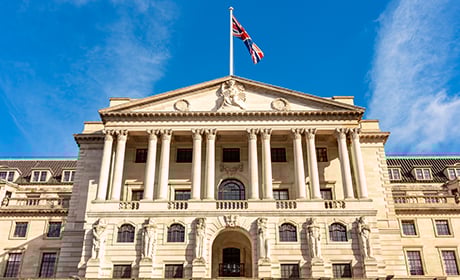
Image of the Bank of England

Summary

Periods of geopolitical stress usually drive investors toward safe assets, with gilts often behaving as the ballast in multi asset portfolios. Yet this time, gilt yields have risen sharply. The apparent contradiction is rooted in energy markets, inflation expectations, and the uncomfortable position in which these developments place the Bank of England (BoE). In this blog, I explore why markets have responded in this counter intuitive way, what history tells us about such episodes, and what advisers should be thinking about today.


Markets in stress: when the usual playbook breaks

In most crises, investor behaviour is remarkably consistent. Risk assets sell off, capital rotates into safe havens, and government bond yields fall as prices rise. The “flight to safety” pattern has been documented repeatedly - from the 1990 Gulf War to the Eurozone crisis, and even during the early days of the pandemic.

Gilts have traditionally been part of that safety complex, backed by a sovereign that controls its own currency. Yet since the escalation of the Iran conflict last week, we’ve seen the opposite: gilt yields rising at the very moment one would expect them to fall. When the behaviour of a familiar asset class suddenly flips, it usually signals that another force is overpowering the typical psychological response.

This time, that force is energy.

The Strait of Hormuz effect: why energy dominates the narrative

Roughly 20% of the world’s oil and gas flows through the Strait of Hormuz every day. Its effective closure to tankers - driven by heightened risk of Iranian attacks - has sent global benchmark prices sharply higher. Brent crude has jumped from $61 at the start of the year to nearly $120 earlier this week.

Although the UK only sources some of its energy needs from the Middle East (most comes from the North Sea or Norway), the price we pay is determined by global benchmarks. UK petrol, diesel, heating costs and shipping rates all key off the price of oil. In addition, we do source some refined products directly from the Middle East - for example over one third of the jet kerosene used to fuel airplanes comes to the UK via the Strait of Hormuz. Even food inflation is partly driven by transport costs. When global oil prices spike, the impact may be indirect - but it is felt quickly and widely.

This is where the historical analogy becomes useful. Energy shocks tend to behave like slow punctures rather than blowouts. In the 1973 and 1979 oil crises, inflation didn’t spike instantly. Instead, it seeped through supply chains - fuel, logistics, imported goods - before hardening into wage demands. The Bank of England is trying desperately to avoid repeating that sequence.

The Bank of England’s dilemma: transitory vs persistent inflation

The BoE’s mandate is clear: keep CPI at 2%. But an externally driven energy shock pushes inflation higher in the near term. In theory, central banks can “look through” one‑off price rises. In practice, they fear second‑round effects - particularly wage inflation that embeds higher prices into the economic system.

This is the heart of the gilt sell‑off.

Until last week, markets broadly expected the BoE to begin cutting rates later this year. Now, the risk is that instead of cutting, policymakers may need to stay on hold longer - or even raise rates - to prevent energy‑driven inflation from becoming entrenched. When the expected path of interest rates shifts higher, gilts fall. It is expectations, not events, that drive prices - something I have emphasised in many previous blogs.

This dynamic mirrors episodes such as 2008 and 2022, when inflationary shocks (food and energy in both cases) forced central banks into more hawkish stances than markets were prepared for. The surprise, not the inflation itself, moved prices.

Why this matters for portfolios

Gilts have long been a key diversifier in multi‑asset portfolios. When equities fall, government bonds usually cushion volatility. This negative correlation has been valuable for decades.

But when the crisis itself is inflationary, government bonds can behave very differently.

The last two major examples - the inflation spikes of the 1970s and the energy‑inflation episode of 2022 - show that gilts are least reliable precisely when the source of risk is inflation rather than growth. If inflation expectations rise faster than growth expectations fall, bonds can sell off alongside equities.

This is the environment we may be re‑entering.

When gilts cannot be relied on to diversify equity risk, we must look elsewhere.

Actionable insights for advisers

  1. Diversify your diversifiers
    Check that your clients’ portfolios don’t solely rely on gilts to hedge downturns, especially during inflation‑linked shocks. Broader sources of defensive ballast matter: overseas currency exposure, systematic hedges, gold, high‑quality alternatives, and selected commodities. More broadly, check that your portfolio managers are using all the tools available to them to manage risks.
  2. Reframe client expectations
    Explain that gilt behaviour is not broken - its correlation simply shifts in inflationary episodes. What clients perceive as “unexpected” is historically normal during supply‑driven price shocks.
  3. Stress‑test clients’ financial situations in the event of higher‑for‑longer rates
    Advisers should ensure clients are not making financial decisions assuming future rate cuts that may now be delayed. Whether or not to re-mortgage in the near term would be a key example. Within investment portfolios, duration exposure, housing‑sensitive equities, and leveraged strategies deserve renewed scrutiny.
  4. Keep perspective
    Energy shocks can be painful but tend to be episodic. What matters most is ensuring portfolios are not over‑dependent on any single diversifier - especially one that behaves unpredictably when inflation is in play.

If there’s a single lesson from this episode, it’s the same one that underpins many of our previous discussions: markets trade relative to expectations, not headlines. And when expectations shift sharply, even the safest assets can surprise.

Ian Jensen-Humphreys

Portfolio Manager

Ian is a portfolio manager of the Quilter Investors Cirilium and Creation Portfolios. Ian joined Quilter Investors in March 2020 from Seven Investment Management (7IM), where he was deputy chief investment officer. Ian also spent 15 years at Goldman Sachs in risk management and portfolio hedging strategies.

Ian is a CFA charterholder and has a degree in Physics from the University of Oxford.