Search

Risk ratings and risk targets – are you running a risk?

Date: 31 March 2026

4 minute read

As we navigate the volatility-inducing policies of this second Trump presidency, there is even greater scrutiny on whether investment solutions can deliver suitable outcomes in line with an investor’s appetite for risk.

Meanwhile, third-party risk ratings remain as popular as ever. But what do the numbers in a risk rating mean? Can they evidence suitability? And how does a risk rating differ from a risk target?

Running the risk

In 2024, research by NextWealth found that 57% of financial advisers relied heavily on third-party risk ratings when recommending investment solutions for their clients. The popularity of these ratings has surged at the same time as the number of people using multi-asset investment solutions has increased.

Using a risk-rated investment solution is seen as a great way to demonstrate investment suitability aligned with an investor’s risk tolerance. In parallel, advisers can now embed risk ratings within their advice process more easily than ever thanks to the technological advancement of risk-profiling tools and investment research tools. But what is a risk rating and how is it calculated?

A calculated risk

A risk rating is a ‘moment in time’ quantitative assessment based on the expected volatility of an investment solution. A risk rating:

  • looks at the expected volatility of the asset classes held within the solution
  • weighs the expected volatility against the proportion of the asset classes held
  • considers any assumed investment horizon.

Any investment solution can pay a third party for a risk rating. The quantitative assessment can support an advice process by making it easier to align a solution with an investor’s overall appetite for risk.

So, if a risk rating is just a snapshot of the fund or portfolio at the time it’s assessed, what does this mean for its risk profile in future? Taking an example investment solution with a risk rating of ‘5’, how confident can an adviser be that it will stay a ‘5’? And how would it react in times of market stress and heightened volatility? This is where a risk-targeted approach differs and can help support advice processes in a more robust fashion.

The value of investments can fall as well as rise. You might get back less than you invested.

Right on target

The key differentiator of risk-targeted investment solutions is that they have an explicit risk target as part of their investment objective. For example, an ongoing commitment to try and maximise return for a given level of risk. This means advisers can be more confident that the investment will remain aligned to an investor’s risk level, regardless of market conditions. It also means that an adviser, their client, and the portfolio manager are aligned from a risk perspective, with the added assurance that the solution will not drift away from its risk profile – something that risk-rated solutions cannot provide.

Hitting the target

Taking a step back, what does this really mean for advisers?

  1. The risk target can allow advisers to better manage their clients’ expectations as the expected returns are associated with the risk taken.
  2. The risk target can be used to enhance capacity-for-loss conversations, particularly by focusing on any potential downside risk.
  3. The risk target and expected returns can also be used as a basis for more accurate assumptions in any cashflow modelling processes.

However, perhaps one of the biggest advantages of a risk-targeted approach is that the investment is continuously managed in a way that is aligned with an investor’s appetite for risk, eliminating the threat of any potential drift.

Risk on? Risk off? Always risk targeted

So, the theory is sound, but let’s consider a real-life example by looking at the Quilter WealthSelect Managed Active 5 Portfolio and considering its risk-target objectives.

The portfolio is rebalanced on a quarterly basis, but the portfolio management team can also undertake ad hoc tactical rebalances at their discretion to take advantage of market opportunities. The rebalances enable the portfolio managers to implement their latest investment conviction, whilst also keeping a sharp focus on the risk profile of the portfolios.

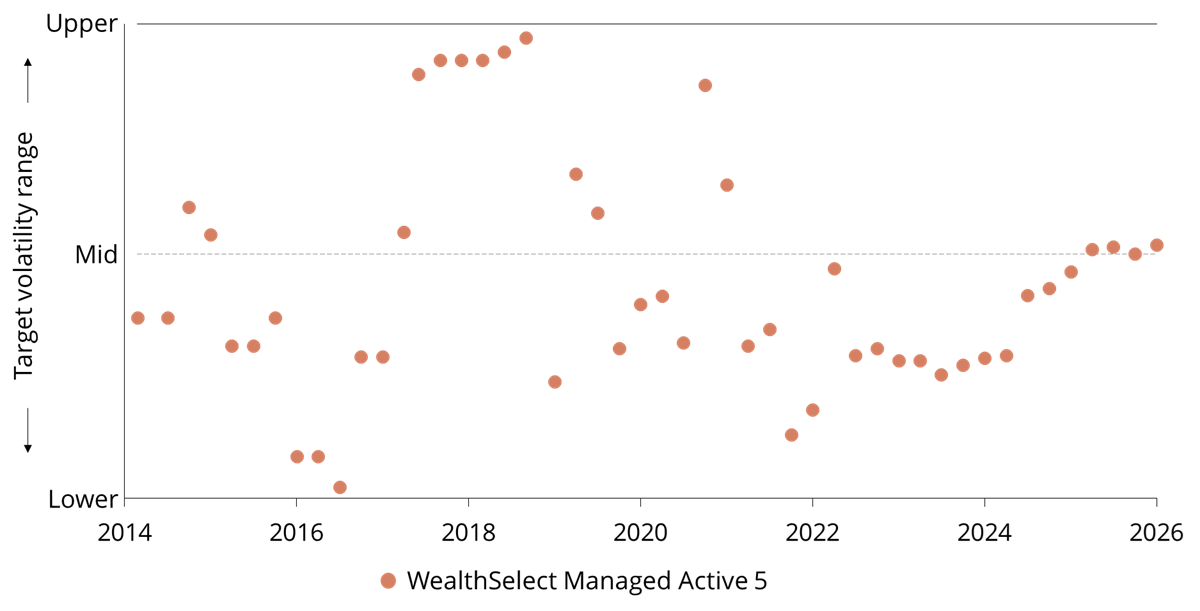
At each rebalance, the portfolio managers ensure that the portfolio continues to target its defined range of volatility. The chart below demonstrates how this is paramount in their decisions. As you can see, the portfolio has remained within its target volatility range at every quarterly and tactical ad hoc rebalance since launch in 2014.

Risk target graph for the WealthSelect Managed Active 5 Portfolio

Source: Quilter as at 2 February 2026. Ten-year forward-looking volatility of the portfolio at time of each rebalance over period 24 February 2014 to 2 February 2026. The WealthSelect Managed Active 5 Portfolio launched on 24 February 2014.

Understanding the risks

It is not to say that solutions which are not risk-targeted cannot make tactical changes to manage risk. However, they are under no obligation to do so.  

Understanding the differences between risk-rated and risk-targeted solutions is essential. While both approaches can be used to strengthen investment suitability processes, risk-targeted solutions provide a more consistent and adaptable approach by providing an ongoing commitment to maintain a specific level of risk.

By continuously ensuring a portfolio is aligned with an investor’s appetite for risk and being nimble to adjust to market conditions, risk-targeted solutions offer a robust strategy for navigating the uncertainty that lies ahead.

Ryan Medlock

Investment Director

Ryan is an investment director at Quilter. Prior to joining Quilter in January 2024 he previously worked for Royal London as a senior investment development manager working closely with advisers to provide technical support, as well as consulting with advisers in the process of developing their investment propositions.

Ryan has a degree in English and Media Studies from De Montfort University.

This communication is issued by Quilter, a trading name of Quilter Investment Platform Limited.

Approver: Quilter March 2026

QI 26871/205/15514