
The page you were trying to view is not available for your role.
Market volatility can cause you uncertainty about what the future might bring or what action you may need to take. As you know, any knee-jerk reactions could derail your plans for the future.
To help you, we have put together answers to some of the questions that you might be thinking about. Before making any decisions, we recommend you speak to you financial adviser.
Market volatility can make it tempting to think about switching your investments into cash on a temporary basis to try and limit further losses. The problem is that no one has a crystal ball to predict future market movements, so no one knows when markets will go up again. This makes ‘timing the market’ not only stressful, but seldom successful.
Also, the biggest gains in the stock market often follow the biggest falls, so if your investments are in cash, you could miss the market ‘bounce’. This was perhaps best highlighted in April 2025 when the US stock market had its worst day since March 2020 closely followed by its best day since October 2008.
Negative headlines can make you feel like it is a bad time to invest when, in fact, it could be the opposite. You could even make the argument that it is better to invest when markets are lower.
By continuing to make regular contributions, or starting your investment journey now, you could potentially benefit from cheaper prices allowing you to purchase more units in your chosen investment funds.
While market falls may seem worrying and bit scary, history tells us that over time market falls are likely to look like nothing more than bumps in road on your long-term investment journey.
As we have seen over recent years and decades, market falls can be quick and deep. However, they recover equally as quickly once the initial panic wears off. If you look at the chart below, even the global financial crisis of 2008, or the more recent Coronavirus pandemic, just appear as small blips when looking at the bigger picture.
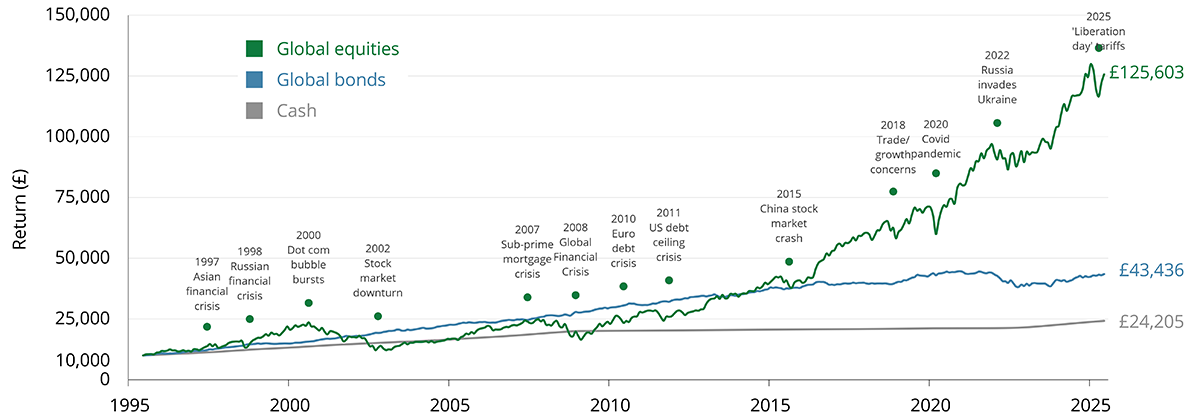
Past performance is not a guide to future performance and may not be repeated. Source: Quilter and Morningstar as at 30 June 2025. Total return, percentage growth over period 1 July 1995 to 30 June 2025. Based on an initial investment of £10,000. Global equities are represented by the MSCI All Country World Index, global bonds by the Bloomberg Global Aggregate Index, and cash by the Bank of England Base Rate. The information provided is for illustrative purposes only and doesn’t represent the past performance of any particular investment. It is not possible to invest directly into an index.
If you are investing for a longer period of time – five years or more – waiting to invest and trying to time the market is likely to result in a poorer outcome.
Looking at historical data, we know that the best days in the stock market often come quickly after the worst. An ideal scenario would be to miss the worst days and catch the best days, but that is virtually impossible as no one knows with certainty how markets will change. Getting it wrong and being out of the market for just a few of the best days, can have a devastating effect on your returns.
As the chart below shows, staying invested is by far the best course of action. To give this more context, there have been 7,639 working days over the past 30 years. Missing just 25 of those days, 0.33% of the total, could have resulted in a difference of nearly £100,000.
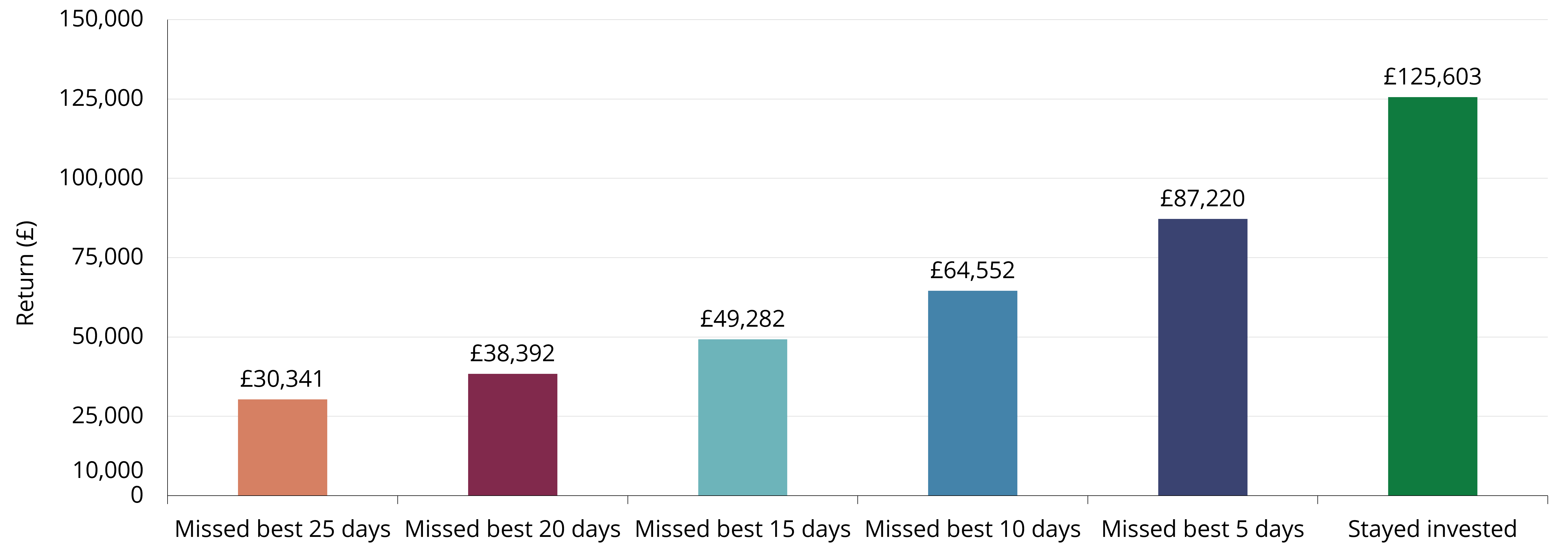
Past performance is not a guide to future performance and may not be repeated. Source: Quilter and Morningstar as at 30 June 2025. Total return in pounds sterling over period 1 July 1995 to 30 June 2025. Based on an initial investment of £10,000 into the MSCI All Country World Index. The information provided is for illustrative purposes only and doesn’t represent the past performance of any particular investment. It is not possible to invest directly into an index.
Investing in cash during periods of volatility can appear very tempting, as it delivers certainty in terms of your return. However, this is likely to expose you to greater risks of inflation eroding the value of your investments, as inflation often exceeds the returns on cash. So, the best way to grow your investments and achieve your long-term goals is by investing in a diversified investment strategy and staying invested.