
The page you were trying to view is not available for your role.
 For many years, passive multi-asset portfolios have been built around a familiar mix of equities and bonds. That approach has served investors well over the long term, but the investment world has changed. Higher inflation, more volatile interest rates, and shifting market correlations have highlighted that traditional diversification can sometimes be less reliable than expected.
Ian Jensen-Humphreys, Cirilium portfolio manager, looks at the use of alternatives within the Cirilium Passive Portfolios and the benefits they have brought to investors over the past two years.
Broadening the toolkit beyond traditional assets
We added alternatives to the Cirilium Passive Portfolios as part of the strategic asset allocation changes made in June 2024 to give us access to a wider investment universe.
Alternatives can sound complex, but the principle behind their inclusion is straightforward. They are designed to behave differently from traditional equities and bonds, giving us another tool to help manage risk and pursue returns across changing market conditions.
In the Cirilium Passive Portfolios, we have used alternatives to complement, rather than replace, the existing allocation to traditional asset classes. The lower-risk profile portfolios initially had a 7.5% allocation from June 2024 to September 2025. Since then, the allocation has been slightly lower at 5%, and it remained at 5% following the most recent change to our strategic asset allocation. The Cirilium Passive Dynamic Portfolio has a lower allocation, while the Cirilium Passive Adventurous Portfolio has no allocation to alternatives.
For advisers, the key point is that our allocation is targeted and proportionate. It is not a wholesale shift away from conventional portfolio construction. Instead, it is a measured enhancement designed to broaden our opportunity set while keeping the portfolios aligned with their respective risk profiles.
Performance has supported the case for inclusion
The early evidence has been encouraging. Since we introduced alternatives into our strategic asset allocation at the end of June 2024, the alternatives index we use in our asset allocation process, the HFRX Index, has outperformed a weighted basket of the four fixed income indices used to represent global government bonds, global investment-grade corporate bonds, UK government bonds, and UK investment-grade corporate bonds. Over the two years to the end of June 2026, alternatives outperformed that fixed income basket by 6.1%.
Asset class returns since 28 June 2024
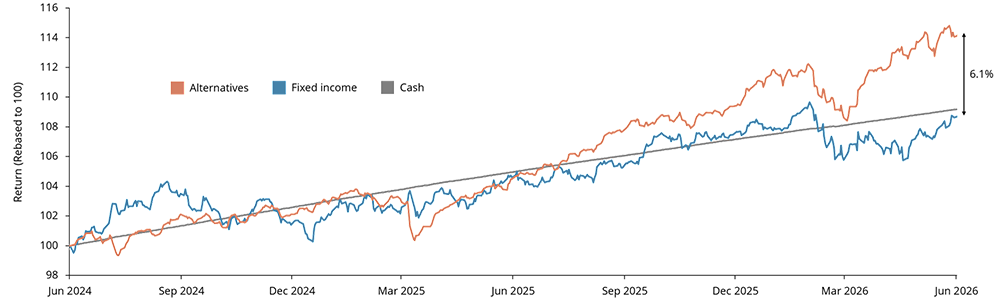
Source: Quilter as at 30 June 2026. Total return, percentage growth, rebased to 100 over period 28 June 2024 to 30 June 2026.
This matters because, for many investors, fixed income has traditionally been expected to provide ballast when equity markets are unsettled. However, recent years have shown that bonds can also experience meaningful volatility. Against that backdrop, the performance of alternatives has provided a useful additional return stream within the portfolios.
Diversification has been helpful, but not perfect
It is important to be balanced. Alternatives have not provided perfect diversification from equities over the period. In the worst two months for equities, both alternatives and the fixed income basket also lost money. In one month, both fell by around 55% of the fall seen by equities, while in another they fell by around 12% of the equity fall.
That said, alternatives delivered a similar benefit as a diversifier over the period when compared to fixed income. Our alternatives basket showed a correlation of around 73% to equities, while the fixed income basket showed a lower correlation of around 43%. Ordinarily, one would look for lower correlations as evidence of better diversification, but, in this case the lower correlation from fixed income was mostly because it lost money in some months when equities rose, which is not necessarily the type of diversification investors would value most.
This is an important nuance. Diversification is not only about looking different on paper, but also about how assets behave when your clients most need support. Alternatives have not been a silver bullet, but they have contributed to a broader and more flexible portfolio structure.
Drawdowns show a clearer advantage
The drawdown experience provides a stronger case for the allocation. Over the two-year period, both alternatives and fixed income experienced far lower drawdowns than equities. Alternatives had a peak drawdown of 3.4%, fixed income had a peak drawdown of 3.9%, while global equities (represented by MSCI ACWI) fell by 17.4% during their worst sell-off.
Asset class drawdowns since 28 June 2024
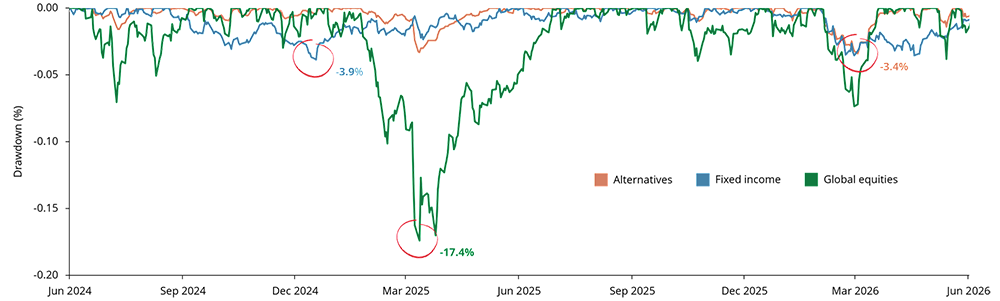
Source: Quilter as at 30 June 2026. Drawdowns of each asset class over period 28 June 2024 to 30 June 2026.
There is also a useful behavioural point here. Alternatives were more likely to experience peak drawdowns at similar times to equities, but they recovered more quickly to regain period-high levels. By contract, fixed income spent much more time below its period high.
For your clients, shorter periods under water can make a meaningful difference. It may help them stay invested, maintain confidence in their plan, and avoid making emotional decisions during periods of market stress.
The underlying funds have delivered
The selected alternatives holdings have also performed well relative to the HFRX Index. Since their additions to the portfolios, both funds have outperformed the index. The Goldman Sachs Absolute Return Tracker Fund delivered stronger absolute performance, though with higher tracking error and higher drawdowns than the index. The State Street Global Alternative Beta Fund delivered lower tracking error and lower drawdowns than the GS strategy, although it still experienced slightly higher drawdowns than the index on occasion.
This performance is particularly important because the decision to include alternatives was not simply an asset allocation call. The implementation was also key – we needed to be confident that we could access a well-constructed passive investment with sufficient liquidity in an efficient and cost controlled way. Following discussions with a number of providers, we decided to partner with State Street, primarily due to their high-quality process for delivering the target exposure with a low tracking error. They did not have a UCITS version of their fund available in June 2024 but agreed to launch one for us, with the Cirilium Passive Portfolios acting as seed capital and anchor investor. We also invested in the Goldman Sachs Absolute Return Tracker Fund. This strategy was already open, at scale, and had a live track record from January 2015, with assets of around £770 million at the time of our investment.
Once the State Street Global Alternative Beta Fund launched on 11 September 2024, we split our alternatives allocation between the two strategies. This allowed the portfolios to benefit from the appeal of the State Street process while also allowing time for the fund to build a live track record. Today, we hold around 75% of our alternatives assets across the Cirilium Passive Portfolios in the State Street fund, with the remainder in the Goldman Sachs strategy.
A stronger passive proposition
The addition of alternatives has strengthened the Cirilium Passive Portfolios by giving us access to a broader investment toolkit. The allocation has helped widen our opportunity set, added a differentiated return stream and, so far, delivered better performance than the fixed income basket we use for comparison.
It has not removed risk, nor has it provided perfect diversification from equities. However, it has shown encouraging performance, lower drawdowns than equities, and a useful role alongside fixed income. If you are looking to explain the value of a modern passive multi-asset approach to your clients, that is a compelling message.

Ian Jensen-Humphreys
Portfolio ManagerIan is a portfolio manager of the Quilter Investors Cirilium and Creation Portfolios. Ian joined Quilter Investors in March 2020 from Seven Investment Management (7IM), where he was deputy chief investment officer. Ian also spent 15 years at Goldman Sachs in risk management and portfolio hedging strategies.
Ian is a CFA charterholder and has a degree in Physics from the University of Oxford.
The value of investments can fall as well as rise. Your clients might get back less than they invested.
Approver: Quilter, September 2026
QIP 24256/206/18237