
Search

2025 unwrapped: perceptions vs reality

Date: 11 December 2025

5 minute read

A young man working on his laptop

It might be controversial for people working outside of finance, but in my view Trading Places is one of the great Christmas movies. One of my favourite scenes is one in which Eddie Murphy’s trader character captures the behaviours of the market succinctly. When talking to his boss about prices in the lean hogs market, his sense is that the price moves were driven by traders’ fears that they might not have enough bonus money to pay for their kids ‘GI Joe with the kung-fu grip’.

This observation, that ‘feelings’ can tend to drive markets, combined with a discussion with some colleagues on the drivers of the year, made me reflect on how much of our perception can be distorted by feelings. With that in mind, and to cap the blog for 2025, I thought it would be good to review the year, but doing so through the lens of how different our perceptions of the year may have differed from the reality.
Perception 1: AI stocks have been the only sector worth investing in

Reality: It has certainly been true that AI stocks have continued to lead broad index returns. For the ACWI index, just over half of the year to date* returns of 14.3% have come from the communication services and IT sectors, despite those sectors only averaging about 34% of market cap.

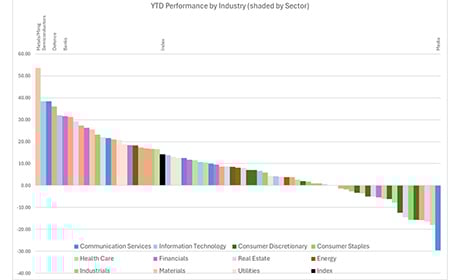
Some of this is a reflection of index composition and, when we examine index performance by subsector (ignoring weightings in the index), there is a more nuanced picture. Certainly, many of the top performing subsectors are AI related (e.g. semiconductors including NVIDIA, interactive media and services including Alphabet).

But other thematic exposures have also been strong performers: ‘Metals and Mining’ is the best performing sector (+53.6% v second best semiconductors at +38.4%). Fears of fiscal profligacy and retail buying of gold have pushed gold prices, and gold mining company prices higher. Similarly, strong performance from ‘Aerospace and Defence’ (+36%) reflects renewed focus on defence spending around the globe.

You could argue that these sectors are all relatively niche – but one of the best performers has been one of the largest: ‘Banks’ (+31.7%). Low starting valuations and better than expected lending performance, led to some material moves in big names like Santander (+130.1%) or JP Morgan (+26.1%).

The upshot is that if you are a passive/index investor, then AI will have been the dominant driver of your returns, but  this was not the only sector that delivered this year.

Perception 2: AI stock leadership has meant that the US has been the best market

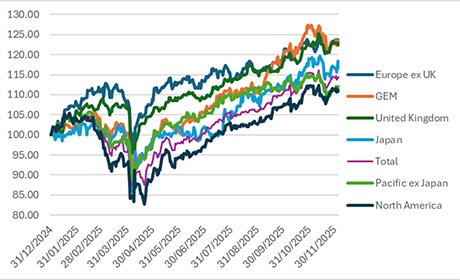
Reality: So, we have seen that AI stocks have been some of the best contributors to global equity performance. But this year, that hasn’t translated into US outperformance. Indeed, when we consider the major regions, the US is the laggard.

US equity market returns for the year are only +11% (versus the ACWI at 14.3%). In fact, the joint leaders are Europe and GEM, both coming in with +23.7%. It’s worth noting that currency effects have been a headwind for Sterling investors in US equities, while providing a boost to returns on European equities.

And while the thematic drivers which were positive globally were also positive for Europe and EM, it goes to show that the US is not the only place that is benefitting from these trends.

Perception 3: global growth is slowing, the consumer is weak and economies can do with a boost from rate cuts

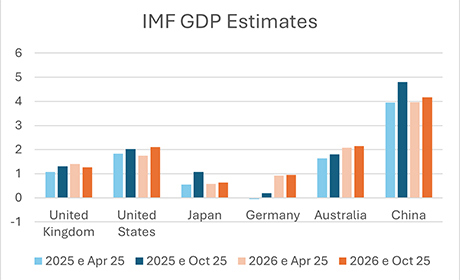
Reality: Growth rates are certainly not high. GDP growth estimates for 2025 range between just 0.2% for Germany through to 4.8% for China, and although in most cases these growth rates are expected to increase for 2026, their levels remain well below historical averages.  

But from a positive perspective, we note that growth rates have been revised upwards. Between April and October of this year, the IMF have increased their 2025 GDP growth expectations by between 20bps and 80bps. From a consumer perspective, unemployment rates are lower than historical averages.

Undoubtedly, central banks being in rate cutting mode, and given the near-term dynamic for increased government spending, policy levers are generally biased towards supporting economic growth.

So, all in all, growth rates are not exciting, but prospects are not bleak.

What factors might be significant for 2026 performance?

The clear and obvious thematic trend, which is likely to continue to drive performance, is whether AI stocks are in bubble territory or not. My colleagues have discussed this in previous blog posts (Are we in a bubble? and Diversity and keep investing) and I won’t rehash the arguments here. But here are a few key events that we’ll be watching over the course of the year:

Quarterly US earnings

    • The first quarter’s earnings season reporting will be helpful to glean how both corporates and consumers have been faring in the final quarter of 2025. As always, the banks kick off reporting in mid-January. NVIDIA is one of the last companies to report in late February.

May

    • Jerome Powell’s term as Federal Reserve Chair will come to an end in May. Although we will know the Chair-designate well ahead of this, it will be interesting to see how the independence of the Fed actually shifts in practice once the new Chair settles in.

G7 Summit

    • France is hosting the G7 summit in Évian-les-Bains this year and the statements made at the conclusion of the summit will be instructive. In particular, it will be interesting to understand how the group’s views on defence are shifting.

November US midterms

    • The US midterms will be held on 3 November and the result will be instructive for understanding how President Trump will likely shift policy focus.

2025 has been a very busy year and no matter what direction the markets go, 2026 is likely to be the same.

We’d just like to thank you for reading our blog posts this year, and we wish you a restful and very merry Christmas, and a happy new year.


CJ Cowan

Portfolio Manager

CJ is a portfolio manager of the Quilter Investors Cirilium and Monthly Income Portfolios. CJ joined Quilter Investors in August 2018 from Aberdeen Standard Investments where he worked in the global macro team, managing global government bond and global aggregate portfolios.

CJ is a CFA charterholder and has also completed the Chartered Alternative Investment Analyst qualification. CJ has a degree in economics from the University of Bristol and an MPHil in Economic and Social History from Brasenose College, University of Oxford.

Ian Jensen-Humphreys

Portfolio Manager

Ian is a portfolio manager of the Quilter Investors Cirilium and Creation Portfolios. Ian joined Quilter Investors in March 2020 from Seven Investment Management (7IM), where he was deputy chief investment officer. Ian also spent 15 years at Goldman Sachs in risk management and portfolio hedging strategies.

Ian is a CFA charterholder and has a degree in Physics from the University of Oxford.

Sacha Chorley

Portfolio Manager

Sacha is a portfolio manager of the Quilter Investors Cirilium and Creation Portfolios. Prior to joining Quilter Investors in 2011, Sacha worked at Broadstone with their team of economists before moving into asset allocation and fund manager research.

Sacha is a CFA charterholder and has also completed the Chartered Alternative Investment Analyst qualification. Sacha has a degree in Maths from the University of Bath.