
The page you were trying to view is not available for your role.
The Financial Conduct Authority's (FCA) Sustainability Disclosure Requirements aim to ensure that ‘financial products that are marketed as sustainable should do as they claim and have the evidence to back it up’.
How do they do this?
Greenwashing is the practice of making exaggerated, misleading, or unsubstantiated sustainability claims to attract consumers and encourage them to invest in a product.
The term ’anti-greenwashing‘ is often associated with rules and guidelines that ensure sustainability-related claims are fair, clear, not misleading, and consistent with the actual sustainability characteristics of the product or service.
The anti-greenwashing rule is designed to deter deceptive or misleading marketing practices. It is designed to ensure any sustainability references made by a firm are fair, clear, and not misleading, as well as being proportionate to the sustainability profile of the products and services in question.
The FCA has four investment labels for products with sustainability objectives that aim to improve or pursue positive outcomes for the environment and/or society.
To qualify for a label, a product must have a sustainability objective that is clear, specific, measurable and included in the product's investment objectives. The sustainability objective is an explicit statement of intention to invest 'with the aim of directly or indirectly improving or pursuing positive environmental and/or social outcomes'.
Based on their sustainability objectives and features, products that meet the requirements will be permitted to use one of the following four sustainability labels:
 These products invest mainly in assets that focus on sustainability for people or the planet. Examples may include activities to support the production of energy, for example, from solar, wind or hydrogen.
 These products invest mainly in assets that may not be sustainable now but aim to improve their sustainability. Examples may include investments in companies that are on a credible path to net zero by 2050 or are committed to improving social standards such as human rights.
 These products invest mainly in solutions to sustainability problems with an aim to achieve a positive impact for people or the planet. Examples may include renewable energy generation and social housing.
 These products invest mainly in a mix of assets that either focus on sustainability, aim to improve their sustainability over time, or aim to achieve a positive impact for people or the planet. Examples may include a mixture of investments from the labels above.
What will you see?
Sustainability labels
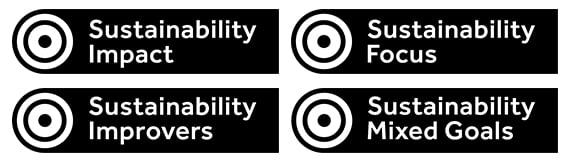
When using the Quilter platform, assets that have a label will have the following;
- The label will be present underneath the asset name as text when selecting funds and exchange-traded investments (ETIs) in the investment selection screens. When accessing the asset screen (by clicking on the asset name), a labelled fund or ETI will have the label in the top-right corner of the screen.
- A consumer-facing disclosure will be available to view on the same page in the bottom-left of the screen within the list of documents. It will also be presented to you with other key documents when completing new business, switch, or top-up activities.
- The option to search for an investment label has also been added as a filter within the advanced search options when using the investment selection screens.
Assets with stated environmental, social and governance (ESG) characteristics
Assets with stated ESG characteristics that do not have a label will have a consumer-facing disclosure that explains what environmental, social, or governance characteristics the asset has and why they have not applied a label. This document will be made available within the same screens as the assets that have a label.
Overseas notice
Some products are based overseas and are not subject to the Sustainability Disclosure Requirements. This will be highlighted when selecting an overseas asset.
Remember that a sustainability label is not an indicator of future performance and should be considered alongside other information available for the asset, including the consumer-facing disclosure and Key Investor Information Document (KIID) or Key Information Document (KID).
Find out more
You can find more information about the Sustainability Disclosure Requirements on the FCA website.